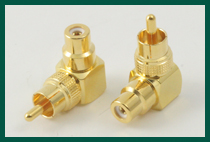
Adapters: lots of fuss over next-to-nothing
There seems to be some "cable lore" out there about adapters: specifically, that adapters cause a lot of signal loss or degradation. There are situations where that's so, but for the most part, it really isn't an issue.
Analog Audio and Video
For most usages -- especially in low-bandwidth, low-frequency signals like analog audio -- the one and only issue with adapters is mechanical (and consequently electrical) stability. Adapters need to engage with plugs and jacks, just like any other connecting hardware, and need to make consistent, non-intermittent, non-vibration-sensitive electrical contact. Generally, with good mechanical design and proper plating materials to avoid corrosion and consequent high resistance, adapters make no discernable difference to signal quality.
A good plating material for an adapter is one which is non-corroding. We wouldn't need plating at all, but for the fact that the best materials for conductor quality, such as copper, and the best materials for connector/adapter construction, such as brass, are corrosion-prone. A thin electroplated layer of a non-corroding metal over the surface keeps the underlying metal from wear and oxidation.
What metal should that be? Gold, of course, has become the standard, seen everywhere in consumer audio. This is a bit odd, frankly, but understandable. It has a distinctive appearance, and it is certainly non-corroding, but a significant part of the reason for its use, in consumer goods, is simply that gold sounds fancier than other plating materials. We're rather partial to nickel, the more pedestrian alternative. Nickel is very hard and wear-resistant, and cheaper than gold. And when someone brings up the fact that nickel has a higher electrical resistance than gold, it's good to remember that (1) for most line-level applications, the Borg have it right: resistance is irrelevant, and (2) the microscopically thin layer of plating metal through which the signal passes presents a truly negligible resistive load. The fact of the matter is that both work just great -- we often use gold simply because, in a world where its use has become regarded as a badge of quality, it's easier to use it than to explain.
Higher-frequency Signals:
There are applications where adapters can indeed make a signal quality difference, such that it's nice to avoid them if you can. These typically are things where there is a very high-bandwidth, high-frequency signal running through. Analog video or digital audio have such long wavelengths and modest bandwidths that you're unlikely to see adapter effects on signal, but HDMI, DVI, Ethernet, SDI and the like can all experience some signal degradation from adapter use. The basic problem is that while impedance consistency is relatively easy to maintain along a cable's length, there are always impedance bumps at connectors and adapters, and minimizing these can be difficult. The longer the length of the conductors in an adapter, the larger that length is as a proportion of signal wavelength, and the likelier it is to cause trouble, typically in the form of return loss but also potentially in areas like skew or crosstalk.
The good news, in such cases, is that because the most sensitive applications here are digital, there's a sort of "digital cliff" phenomenon. Raw signal degradation, up to a point, makes no difference at all because the receiving circuit is still able to tell the ones from the zeros (or, in the case of multilevel encoding, the various levels from one another) until the degradation reaches a critical threshold. At that threshold -- the ""digital cliff" -- things fall apart. This tends to mean, in practice, that if degradation isn't noticeable, it likely isn't enough to make a non-noticeable difference, either. In HDMI or DVI, for example, if you're not seeing "sparkle" pixels which represent digital dropouts (or, in severe cases, whole-line dropouts or loss of sync), you are almost certainly getting perfect signal reception, with the raw signal degradation having no actual effect on performance.
The upshot? Yes, degradation from adapters is a real thing, and a genuine possibility. But people worry about it much more than they should, and in most cases if you're not seeing or hearing an obvious problem, everything is just as it should be.




 Adapters