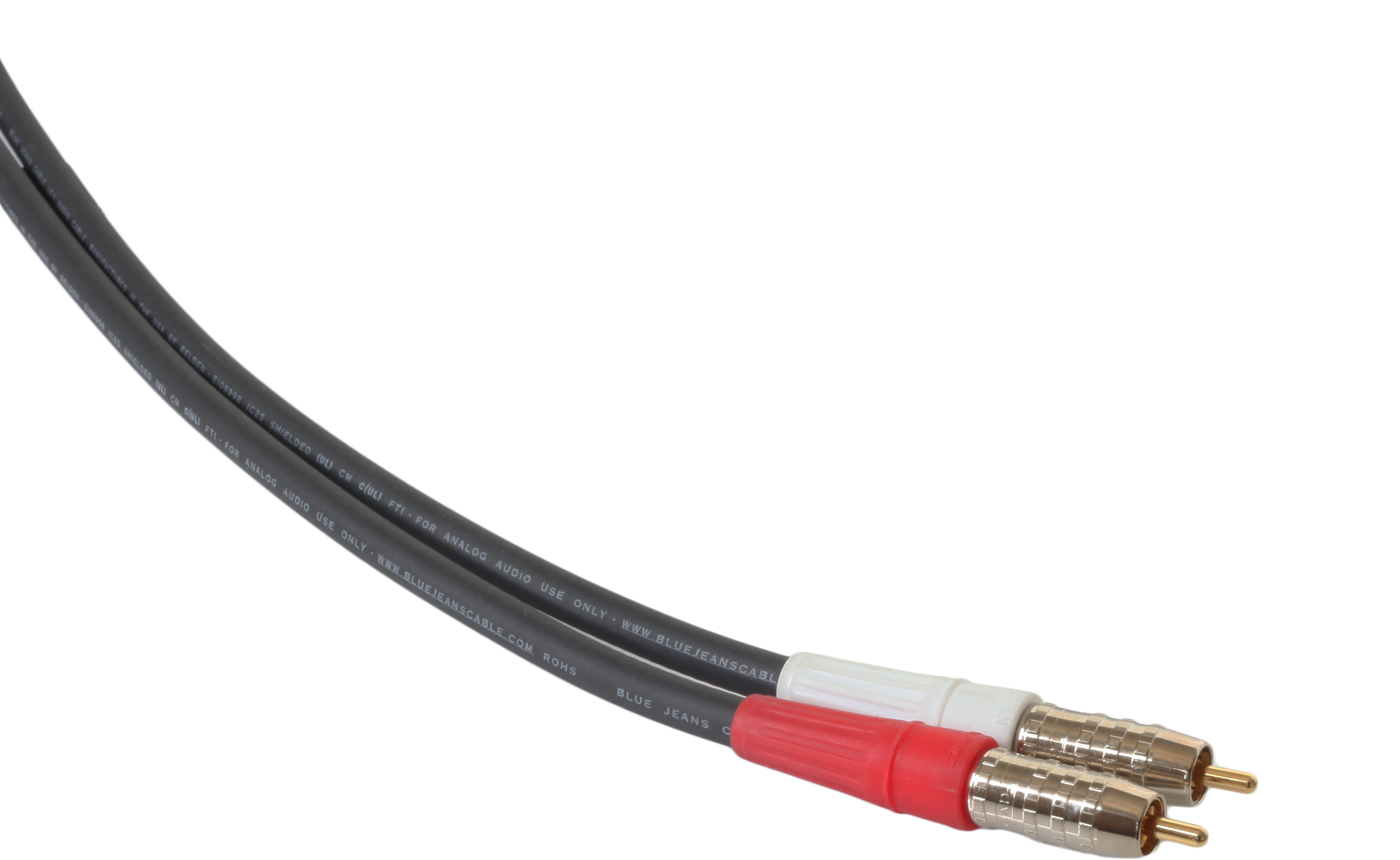
Stereo Audio Cables Our RCA-terminated stereo audio cables offer low capacitance and excellent shielding for neutral, noise-free performance
✖ BJC LC-2 and LC-1 Stereo Audio Cables:
✖ Stereo Audio Cables: Alternate Stocks
✖ BJC MSA-1 Miniature Stereo Audio Cable:
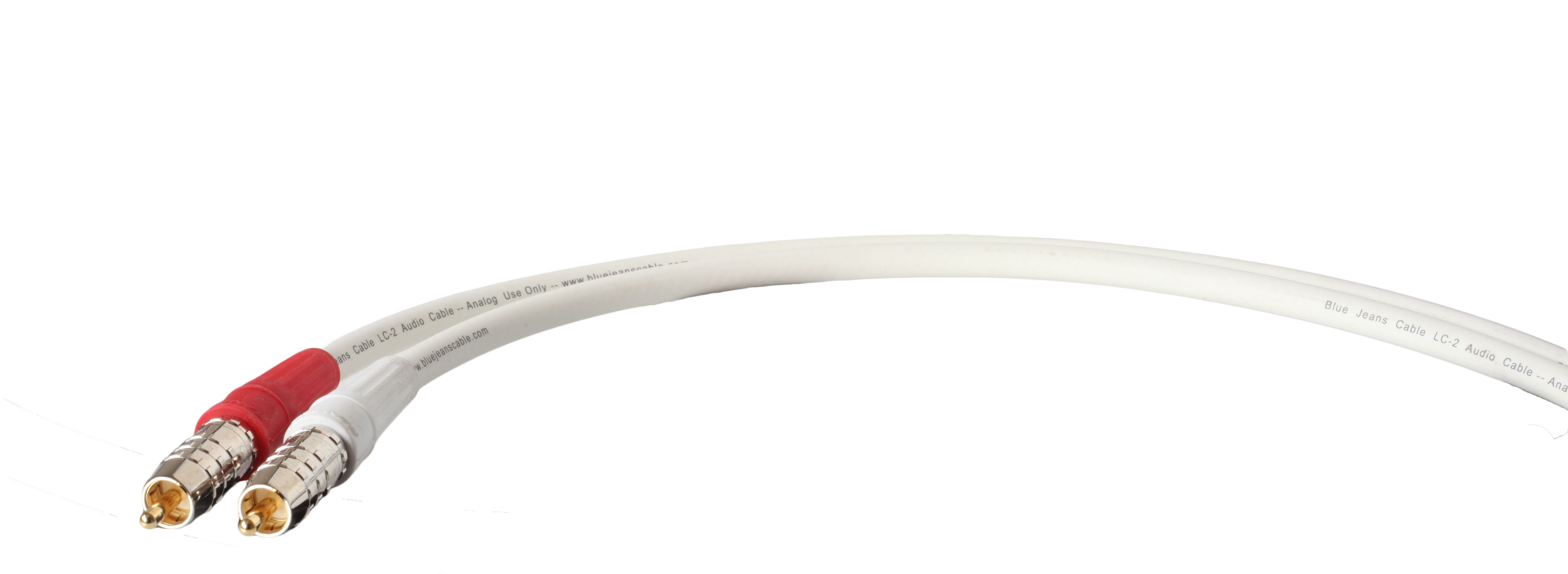
Blue Jeans Cable LC-2 and LC-1: Our own proprietary design for unbalanced audio: highly flexible, low capacitance, with heavy double-braid shielding
BJC LC-2 and LC-1:
When we first ventured into the cable business years ago, unbalanced audio seemed like a neglected application. Cheap cable stocks consisting of a pair of conductors with minimal shielding were common, and the best cables we could find for it were simply 75 ohm video cables, repurposed with RCA plugs. And while some of those video cables work very well, they were optimized around functions and bandwidths very different from those of an analog audio cable.
The most important attributes of a line-level unbalanced audio cable are (1) shielding, and (2) capacitance. Heavy shielding protects audio signals from interference from outside sources, as well as providing a solid ground path for the avoidance of ground loop noise. Both LC-1 and LC-2 use a heavy double-braid shield, with one bare copper braid laid directly over another for extreme high coverage and high conductivity to ground; this is the identical shield configuration to Canare LV-77S, which tested best in our review of audio cable hum rejection characteristics (LC-1 and LC-2 hadn't been designed yet, so weren't tested at that time). By shrinking the center conductor to 25 AWG and foaming the polyethylene dielectric, we were able to get capacitance down below 11 pF/ft, much better than LV-77S at 21 pF/ft. Capacitance can be important, particularly in long cable runs, because it contributes to rolloff of higher frequencies. The softer dielectric material and smaller center conductor, meanwhile, make the cable highly flexible and easy to route despite its relatively thick profile.
LC-1 and LC-2 are fundamentally the same design, with slightly different implementations; LC-2 is a bit more dimensionally true and a shade lower in capacitance, as well as being less costly. It would supersede LC-1 in our line but for one thing: LC-2 does not carry a National Electrical Code rating and therefore is not legal to install in walls in NEC jurisdictions. LC-1 carries a CM rating, which permits installation in walls (but not risers or plenums) in residential and commercial buildings. Accordingly, we recommend LC-2, unless your installation requires LC-1.
For more information and specs on LC-1 and 2, read our "LC-1 Design Notes" article.
The Connectors: Taversoe Crimp RCA Plugs
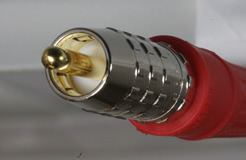
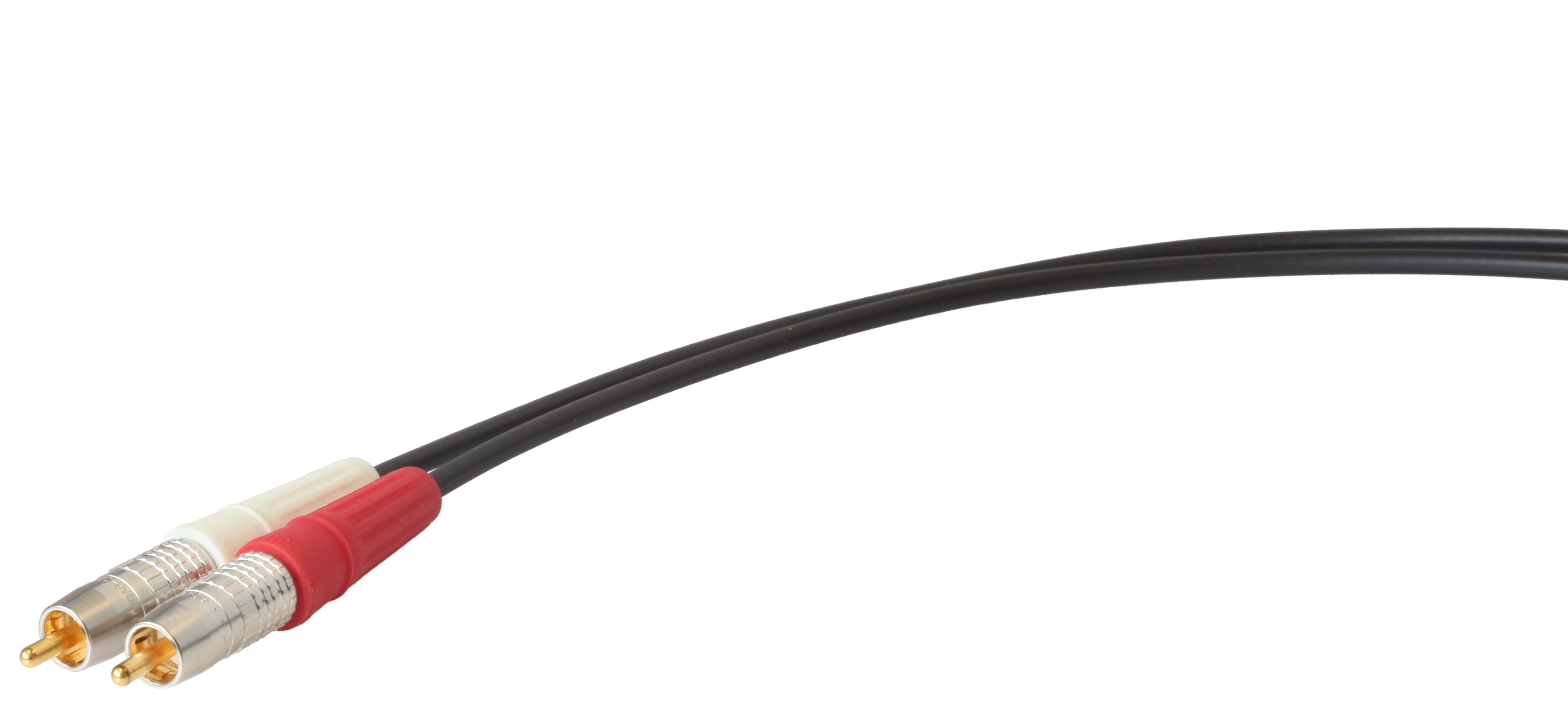
Connectors are a critical part of any audio cable, because if the cable isn't well-joined to the connectors, or if the connectors don't make firm electrical contact with the jacks, it doesn't much matter how good the cable is. Our LC-series cables are terminated with the Taversoe RCA plug, a high-quality RCA plug with an all-metal body and shell specifically designed for the perfect dimensions for use with LC-1 and LC-2. Its all-metal body, crimped tightly to the shield braid, completes the shielding assembly from cable end to cable end, to ensure that the cables do not become an entry point for noise. These plugs are gold-plated on all jack-contact surfaces, and employ a set of leaf-spring style grippers on the outer RCA ring which apply just the right amount of force to the jack to grip it firmly without overtightening.
Other Cable Stocks:Alternative cable types for particular applications
While LC-2 and LC-1 are our primary recommendations, there are special circumstances which may call for something different:
Canare L-4.5CHD: for high-RFI situations
Every now and then, we have a customer who lives right next to a broadcast antenna, and for such people, RFI can be a huge problem. While many people believe, erroneously, that they live in high-RFI environments (those cell phones and wi-fi really do not generate the field strength some people imagine), people like this aren't in much doubt: they can hear the radio station while listening to other sources, because something in the signal chain is picking up and rectifying that RF. In such cases, a braid/foil combination shield is best, and Canare L-4.5CHD, a precision SDI cable primarily used for professional video, is perfect for such cases. It carries a 95% coverage tinned copper braid laid over a 100% coverage foil layer, and many customers have credited it with solving an RFI problem.
Canare L-2.5CHWS: for super-high flexibility
LC-2 is very flexible, but it's still a thick cable. Canare L-2.5CHWS is a much smaller cable, but still has a double-braid shield. It's ideal if you have to fit in small places (though if you've got to go through a hole, do remember that the RCA plugs may have to go through first!) or if you otherwise have need for extreme flexibility and compactness.
Belden 1505F: high flexibility
Belden 1505F is intermediate in size between L-4.5CHD and L-2.5CHWS, with a double-braid shield. It is usually available in a wider assortment of colors than L-2.5CHWS.
Miniature:MSA-1 Audio Cable for compact stereo applications and connectors
For Miniature Applications: BJC MSA-1 Audio Cable
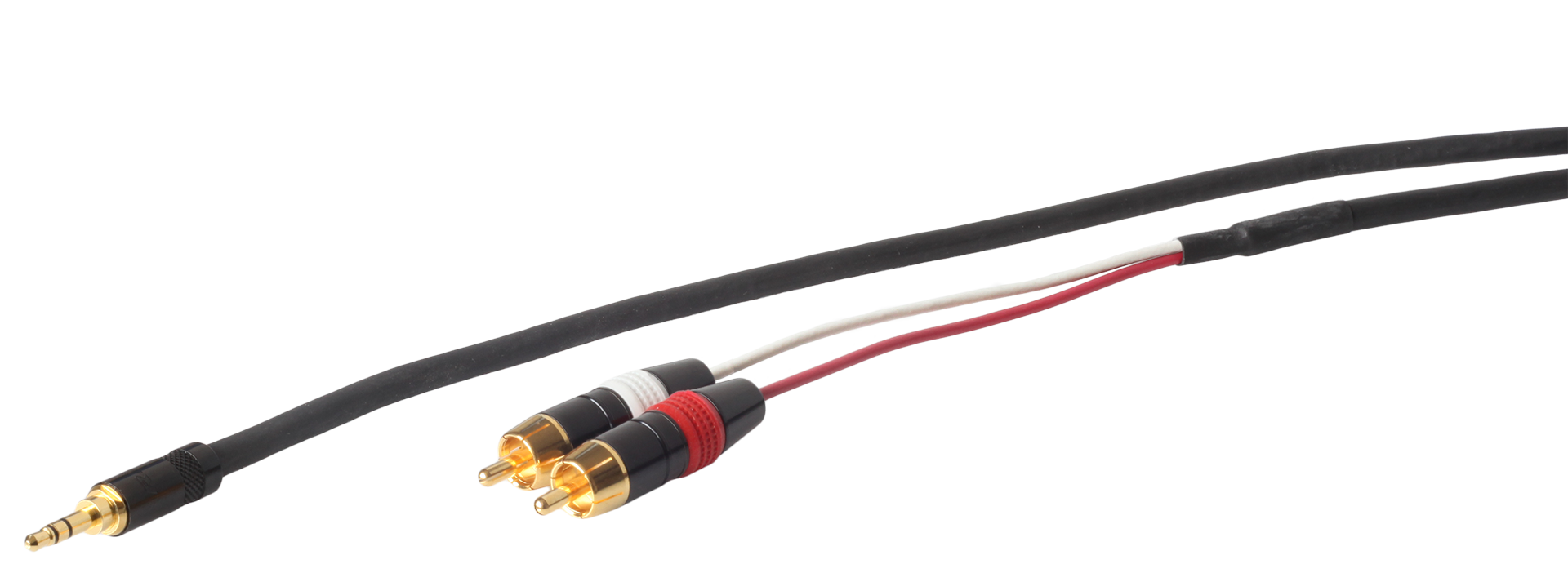
Many portable devices now run analog audio through a 1/8" stereo mini-plug, which isn't compatible with the larger cable size of the LC-2. For these applications, we carry our own miniature stereo audio cable, the MSA-1. MSA-1 is a pair of miniature unbalanced audio cables, wrapped in an outer round jacket; each of these miniature cables carries a full braided shield overlaying a layer of foil, for high shield effectiveness as compared with typical miniature "serve-shield" cables. MSA-1 is made in bulk for us by Belden, and is terminated in our own shop in Seattle; we offer it in a variety of termination options, the most common being 1/8" stereo to a pair of RCAs. This cable is rated CMX under the National Electrical Code, which makes it lawful for in-wall installation in single-family residential applications.
MSA-1 Special Applications:
We also can terminate the MSA-1 in a variety of nonstandard configurations for use as a Y cable, a phase-splitting balanced cable, and the like. Because these applications require separate discussion, we have put them on our MSA-1 Special Applications Page.
"RCA" Audio: the Basics Unbalanced analog line-level audio, usually carried through RCA connectors, is pretty straightforward: good shielding and low capacitance produce a clean, low-noise connection. This calls for a coaxial, rather than paired, cable architecture with an emphasis on shield coverage and quality.
Need to Know More? The "More Details" buttons under each product above will give you a rundown on what we recommend and why, as well as special options (e.g., different connectors, alternative cable stocks) we offer.
A Deeper Dive: Analog Unbalanced Audio: A Guide to Some Myths and Practical Truths




 Stereo Audio Cables