AudioVideoData
Accessories
Info
S-Video Cable
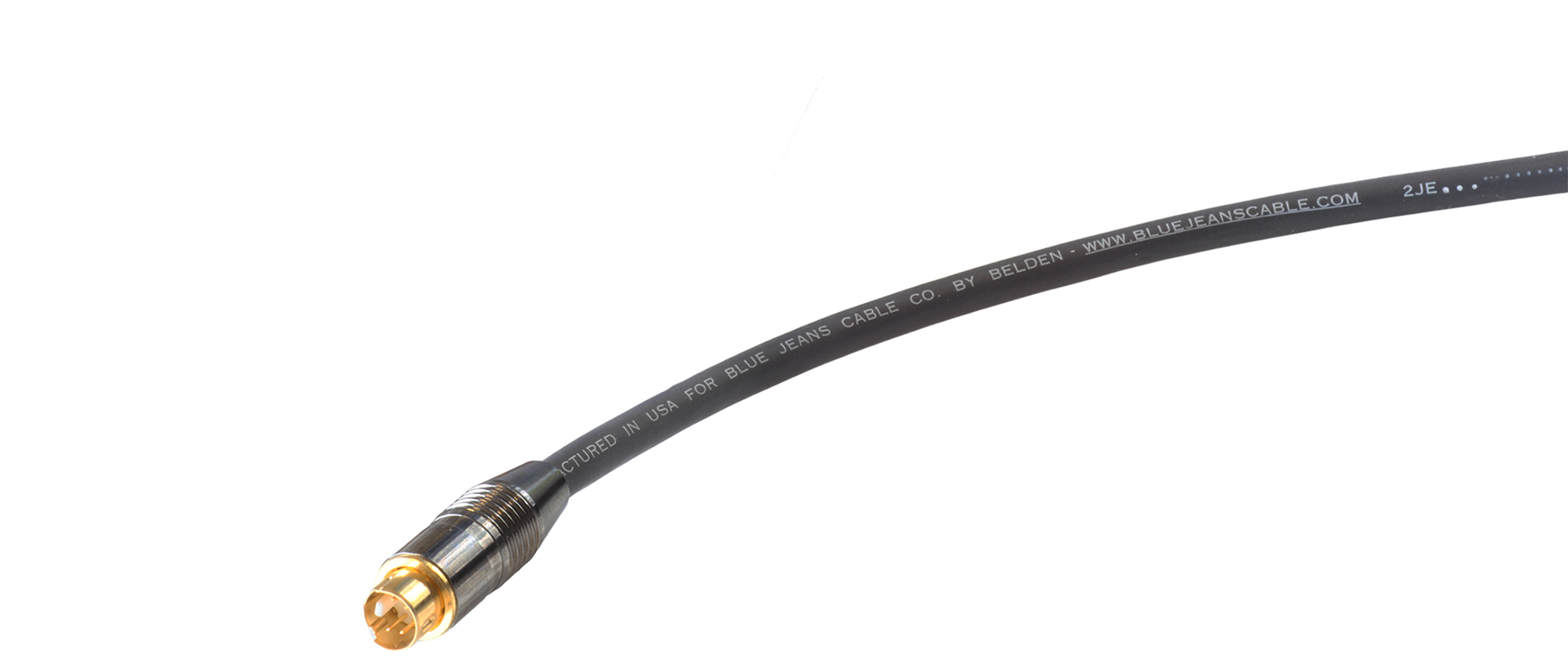
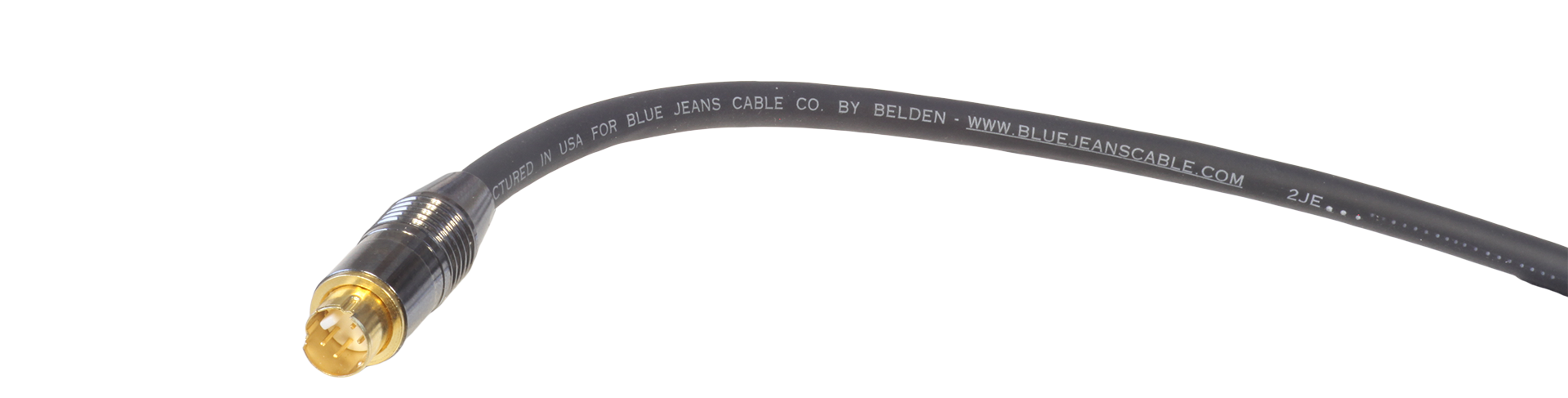
YC-2 S-video cable: 
S-video cable presents a couple of basic problems, both related to size. Because s-video cable needs to be small to maintain high flexibility (so that the mini-DIN plugs, which have no grip mechanism, won't pry themselves out of equipment jacks) and to fit the limited available cable entry room in a mini-DIN connector, the tolerances in s-video cable typically aren't very tight--and the shielding often isn't what it should be. With this in mind, we decided to custom-design our own s-video cable; we asked Belden to build us a cable the same size as its standard 1808A s-video cable, but with enhancements. First, we changed the center conductor from stranded to solid, to help control impedance better. Second, to further contribute to impedance control and dramatically improve noise rejection, we changed the shield configuration completely; where 1808A has a "serve" shield and no foil, our design has a 100% coverage foil layer and a 90% coverage tinned copper braid. The result, which we call the YC-2 S-video cable, has improved impedance tolerance (+/-3 ohms, as compared to the typical +/-5 ohms) and improved shield effectiveness as compared with typical stock s-video cables.
After reviewing many samples of 4-pin mini-DIN s-video plugs from a variety of manufacturers, we've had these s-video plugs made to our requirements. The pin body is strong, and the pins are as bend-resistant and migration-resistant as any we can find. Strain relief on the cable is highly effective, provided by a robust internal cable clamp which grips right in to the cable jacket, taking the stress of bending and pulling entirely off the solder joints. The pins and the outer contact surface are all gold-plated for solid, no-corrosion contact. We cut, terminate and test all of our s-video cables in our own shop in Seattle, Washington.
Our recommended S/PDIF cable for most applications is Canare L-4.5CHD. This cable is suited for 12G SDI -- far beyond the bandwidth required for S/PDIF. The shielding is a dense tinned copper braid laid over an aluminum/mylar foil; these shield materials complement each other, with braid more effective in reducing EMI and foil more effective at RFI, and with the braid providing excellent conductivity to direct noise to ground.
Impedance stability is important in carrying digital signals, and impedance depends upon dimensional consistency throughout the cable from tip to tip. The ordinary connector for S/PDIF, the RCA plug, isn't ideal for this. Its dimensions are wrong, the jacks which contain the dielectric at the mated ends may have any sort of dielectric in them, and many RCA plugs -- especially soldered plugs with a hollow metal backshell -- depart from 75 ohm impedance along the whole length of the plug. What to do? Use a better plug.
Canare RCA plugs are a three-piece crimp design, rather than the usual solder type RCA; their construction is, in most details, more like a broadcast-quality 75 ohm BNC plug than it is like a typical RCA. Where the shield is stripped, its role is taken over by a brass metal tube of the same diameter as the shield, keeping dimensions consistent through connectorization. The internal dimensions don't change to "RCA plug" dimensions until the last possible point, meaning that the zone of impedance mismatch is kept as short as possible. And at the jack end is another great feature: a circular leaf spring grips the ground contact of the jack, with the result that the grip is solid and electrically sound, but without the over-tightness of many simple cast brass connectors; it will disengage without the risk of jack damage.
While L-4.5CHD is our recommended cable, there are others available. Belden 1694A is a similar cable to L-4.5CHD, but somewhat costlier. Belden 1505F is a high-flex cable with a stranded compacted center conductor and double braid shielding, good if you need a cable that will be regularly flexed in-use (e.g, cable strapped to an articulating mount arm) or that needs to conform to tight bends.
Most S/PDIF connections are RCA to RCA; however, some high-end and professional gear will use BNC connectors, some laserdisc players use F-connectors, and some audio cards and miniature devices use 1/8 inch plugs. Canare BNC plugs and F-connectors -- true 75 ohm plugs of the highest quality--are available on all of the cables above, and solder-on 1/8" miniplugs are available on the Belden 1505F cable. Just be sure to select the appropriate connector option when adding the cable to your shopping cart, and we'll take care of it.
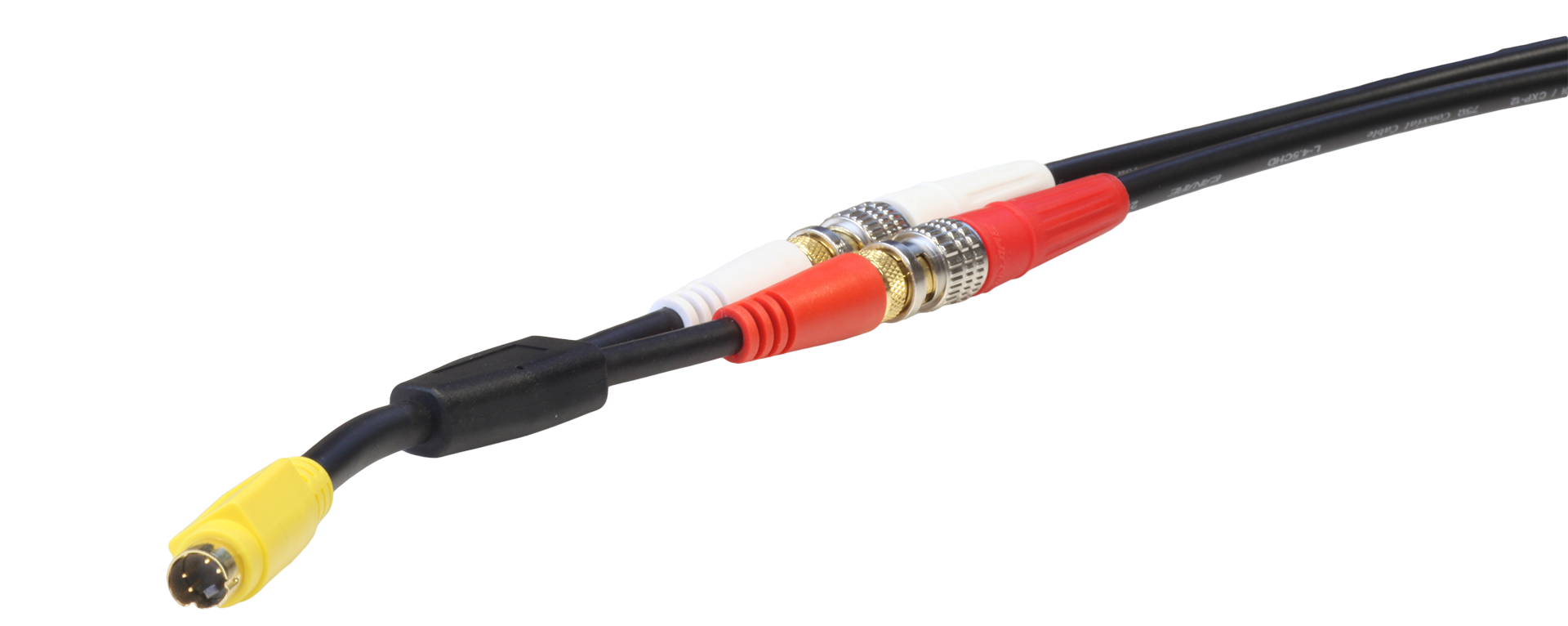
Breakouts:Longer s-video cable assemblies can suffer from attentuation; using adapters and larger cable provides low signal loss over distance
More Details:
Mini-coax, if it's built right, is just great for conveying video signals--but it does result in higher attenuation than you'd get from a full-sized coax. If you need to run S-Video over distances greater than fifty feet, or if you are just the sort of person who can't stand using mini-coax, take a look at our "breakout" cables.
No amount of wedging and squeezing will get two full-sized coax cables into a mini-DIN plug, and even if it could, the pins are so small that you'd have to strip away most of the braid just to get something small enough to solder. The answer to the problem is simple: at each end of the S-Video run is a breakout adapter, with a mini-DIN at one end and two female BNC connectors at the other. Between these breakout connectors, we run our favorite high-bandwidth precision video coax: Canare L-4.5CHD, terminated with Canare BNC plugs (if you prefer another coax, write for a price quote). Instead of a mini-coax, your S-Video signals travel through full-sized, low-loss, high-bandwidth coax, suitable for runs of any length.